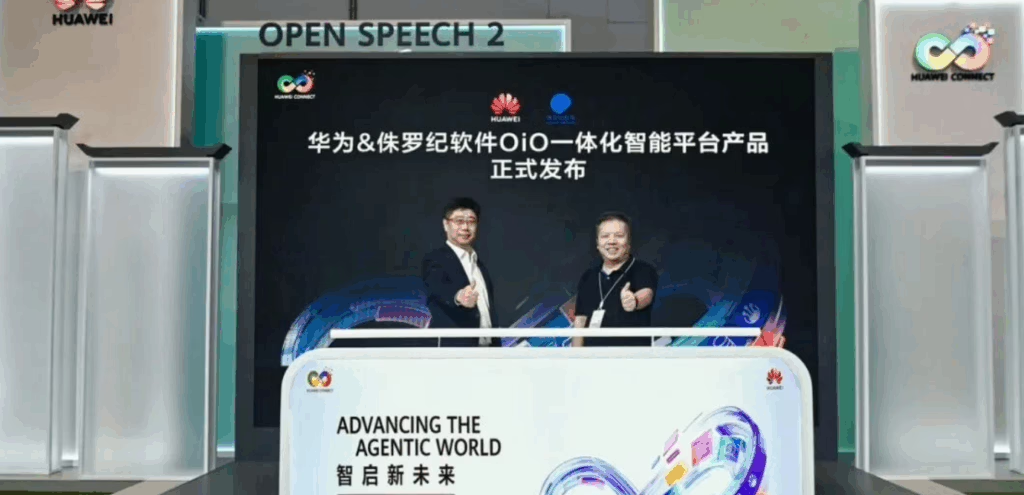
HUAWEI CONNECT 2026 opened in Shanghai on September 17, 2026. Under the theme “Shaping an Intelligent Future,” the event focused on intelligent transformation across industries and the practical application of AI. During the event, Bao Shijie, General Manager of Jurassic Software, and Zou Yong, Head of Solution Sales at Huawei’s Oil and Gas Business Unit, jointly launched OiO (Oil in One), an integrated intelligent platform. Xiao Kun, Deputy General Manager of Jurassic Software, presented the platform’s product positioning, core capabilities, and business value. Designed for the oil and gas industry, OiO is jointly driven by a large model and the Oil and Gas Business World Model (DWM). It connects oil and gas business modeling, the organization of domain resources, and intelligent task execution, providing a shared, reusable foundation for a range of intelligent applications.
With more than three decades of experience in the oil and gas industry, Jurassic Software combines its accumulated domain expertise with AI capabilities. OiO focuses on three interrelated questions: how AI can understand specific business activities, how domain capabilities can be shared across multiple applications, and how the execution and outputs of intelligent tasks can be managed and reviewed. This is also what differentiates OiO: business knowledge, domain resources, and execution rules jointly inform the development and operation of intelligent applications, turning an enterprise’s existing expertise into capabilities that can be reused over time.
An oil and gas business task requires clarity about the objects being handled, the relationships between them, the business definitions and criteria to apply, the domain resources available for use, and the rules that must be followed. Explicitly representing these business conditions provides the foundation for AI to perform domain-specific work. OiO uses a large model and DWM in tandem. The large model handles requirements understanding, reasoning, planning, and the organization and presentation of information; DWM organizes business concepts, object relationships, resource roles, and rule-based constraints, providing domain context and a business basis for each task.
Natural Language · Multimodal Inputs
Domain Knowledge · Context
Business Concepts · Entity Relations
Domain Resources · Business Rules
Through this mechanism, industry knowledge informs resource organization, application development, and task execution: business definitions clarify what a task means, object relationships connect the required information, domain resources provide execution capabilities, and business rules constrain the process. Enabling AI to understand the business is thus implemented through concrete platform mechanisms. Domain professionals’ business requirements can be linked to the relevant data, tools, and models, enabling AI to work with clearly defined business objects and rules.
As intelligent applications become more numerous, enterprises face a practical question: how can the same business definitions, domain model, or working method continue to serve different applications? OiO establishes the foundation for reuse at the business capability layer. Through business definitions, resource curation, quality governance, and access control, the platform organizes business data, industry knowledge, domain models, and software tools into standardized data, model services, tool interfaces, and business templates, while managing their applicable conditions and versions. Reuse therefore has clearly defined boundaries: the business meaning of a capability, the conditions under which it applies, the version to use, and the permissions required are all incorporated into resource organization. This provides a foundation for sharing domain capabilities across applications.
The same set of capabilities can support general-purpose intelligent applications for data querying, visualization, and reporting, as well as business Intelligent Agents for professional roles and business processes, and intelligent business apps for specific domains. The Intelligent Agent Factory supports application development, testing, and release, while JuraWorkspace organizes collaboration around projects, tasks, resources, and deliverables, connecting application development with business use. Enabling new applications to build on existing work means that each business definition, tool service, and task template an enterprise develops can provide a reusable foundation for subsequent application development under the appropriate conditions.
Domain deliverables must make it possible to establish the basis of a task, which tools were invoked, how execution proceeded, and whether the results were reviewed. OiO incorporates these requirements throughout the process, from business objectives to final delivery. Within its architecture of “one integrated platform, two cores, three domains, and six layers,” OiO Core serves as the semantic core, providing business semantics and constraints; Agent OS Runtime serves as the runtime core, supporting state management, invocation scheduling, and exception handling. Together, the two cores enable the platform to organize task planning around business objectives, invoke domain tools, algorithms, and models to execute tasks, and support engineers in reviewing the results.
Context packages, task templates, runtime feedback, and evidence chains span this process, linking the basis of each task with its execution and results, and connecting AI planning capabilities, domain tool execution capabilities, and engineers’ judgment. Mechanisms for permissions and security, versioning and traceability, runtime observability, evaluation, and release provide ongoing support for application development and operation. For business users, this means more convenient access to resources, task collaboration, and deliverable generation; for business departments, deliverables have a verifiable basis; and for those building enterprise systems, domain resources and application development can continue to accumulate on a unified foundation.
From exploration and development to drilling and completion, production, and operations, OiO connects domain resources through shared semantics, providing a foundation for industry customers, software and model partners, application partners, and research teams to jointly develop applications. Participants can address real business needs by integrating domain software, computational models, and business Intelligent Agents into specific applications for validation and collaboration. As the platform evolves toward version 4.0, it will also explore knowledge updates driven by feedback from real business activities: issues, outcomes, and improvement suggestions arising from tasks will inform research and, following domain validation, expert review, and quality assessment, be consolidated into reusable knowledge so that validated experience can serve more scenarios.
The launch of OiO represents more than an upgrade in platform capabilities. It also marks a shift toward translating the oil and gas industry’s accumulated knowledge, models, tools, and business experience into AI-enabled productivity in a more systematic, reusable, and continually evolving way. By consolidating shared business capabilities, connecting diverse domain resources, and enabling validated practices to be reused and extended, OiO helps intelligent transformation progress from individual projects to the continuous accumulation of capabilities, and from independent innovation to ecosystem collaboration.
As more industry customers, technology partners, and research teams participate, these domain capabilities, grounded in real business activities, will be continually validated, enriched, and shared. Over time, they will form an evolving system of intelligent capabilities for the oil and gas industry, providing long-term support for more advanced intelligent collaboration and decision-making.
Quick Links
About Us