A Dual-Model-Driven Intelligent Platform for Oil & Gas Exploration and Development

A Dual-Model-Driven Intelligent Platform for Oil & Gas Exploration and Development
Powered by LLMs and the Domain World Model (DWM), OiO integrates business modeling, professional resources, and intelligent task execution, transforming domain expertise into reusable AI capabilities and accelerating AI adoption in oil and gas.
During the digital-intelligent transformation of oil and gas enterprises, multiple barriers still exist among data foundations, business knowledge, system capabilities, and AI applications, limiting the large-scale implementation of intelligent capabilities in core business scenarios.
Oil and gas data comes from diverse sources, follows inconsistent standards, and varies in quality, making it difficult to form reusable, high-quality business data assets that can support intelligent applications.
Industry experience, business rules, and professional workflows are dispersed across experts and systems, making structured knowledge accumulation difficult and preventing systems from truly understanding oil and gas business.
Various professional systems are built independently, making it difficult to connect data, tools, and business processes, which limits collaboration efficiency across disciplines and scenarios.
General-purpose AI cannot be directly adapted to complex oil and gas business processes. A platform that integrates data, knowledge, models, and intelligent agents is required to enable AI to enter core business workflows.
OiO (Oil in One) is an integrated intelligent platform for the oil and gas industry, jointly driven by Large Language Models (LLMs) and the Domain World Model (DWM). Built on oil and gas business modeling, OiO organizes domain knowledge, business data, professional models, algorithms, and software tools into reusable intelligent capabilities, seamlessly connecting business understanding, resource orchestration, application development, and intelligent task execution.
Through unified business semantics and intelligent runtime mechanisms, OiO supports a wide range of applications, including intelligent data querying, analysis, visualization, report generation, and domain-specific AI agents, while ensuring traceable task execution and verifiable results.By transforming accumulated domain expertise and technical resources into reusable intelligent assets, OiO enables oil and gas enterprises to accelerate the scalable adoption of AI across real-world business scenarios.
Natural Language · Multimodal Inputs
Domain Knowledge · Context
Business Concepts · Entity Relations
Domain Resources · Business Rules
OiO’s overall architecture is built on a unified Oil & Gas Business World Model. Through the coordinated dual engines of OiO Core and Agent OS Runtime, it connects the three core domains of Resource, Intelligence, and Application, while its six-layer architecture integrates the full chain from business ontology and resource organization to intelligent services and application delivery.
Through outcomes, evidence, and feedback mechanisms, the platform forms a continuously improving closed loop, enabling data, knowledge, rules, tools, and intelligent agent capabilities in oil and gas operations to be unified around real business tasks, executed under control, and delivered with trust.
The Oil & Gas Business World Model enables the OiO platform to understand, organize, and execute oil and gas business operations in a consistent manner, connecting business objects, resources, rules, processes, tasks, and outcomes into an executable intelligent business system.
OiO Core is the business semantics engine of OiO. It centrally manages business coordinates, MBUs, business context, standard resources, and knowledge graphs, enabling the platform to understand the business. It does not undertake enterprise instance data storage, task scheduling, or tool execution.
Agent OS Runtime is the operating core and intelligent task execution engine of the OiO platform. It receives Execution Commands generated by AI Harness and centrally orchestrates resources, rules, context, tools, and models to complete intelligent task execution and trusted outcome delivery in an observable, auditable, and feedback-driven manner.
The Resource Domain is the business resource management and invocation domain of the OiO platform. It is responsible for unified access, indexing, binding, retrieval, authorization, loading, and traceability of various business resources, providing a trusted, understandable, and callable resource foundation for the Intelligence Domain, Runtime, and Evidence Chain.
The Intelligence Domain is the intelligent service and execution-command compilation domain of the OiO platform. It understands user requirements, identifies business objects, locates MBUs, loads context, matches rules and conditions, and plans task chains, ultimately generating MBU Execution Commands that can be executed by Runtime.
The Application Domain is the application delivery and user interaction domain of the OiO platform. It provides JuraWorkSpace, business agent workspaces, business apps, scenario-based intelligent applications, permission workbenches, and outcome display, editing, review, and publishing portals, delivering platform capabilities into concrete business scenarios in a user-operable manner.
OiO’s closed-loop mechanism is a feedback system for the continuous evolution of platform capabilities. Through runtime feedback, expert review, and evidence accumulation, it continuously optimizes business context, resource binding, rule conditions, task chains, and agent configurations, making intelligent oil and gas tasks increasingly accurate and trustworthy through use.

Through business definition, resource curation, quality governance, and access control, OiO transforms business data, domain knowledge, specialized models, and software tools into reusable standardized data, model services, tool interfaces, and business templates.
These capabilities support general-purpose AI applications for data querying, visualization, and report generation, as well as AI agents tailored to professional roles and workflows and intelligent applications for specific domains, enabling organizations to build once, reuse across applications, and continuously expand.
Combine the understanding and reasoning capabilities of LLMs with the domain expertise of the oil and gas Domain World Model (DWM), providing business semantics and rule-based constraints for intelligent applications.
Use proprietary patented technology for minimum business work nodes and business coordinates to map workflows across the oil and gas lifecycle into over 16,000 standardized business nodes.
Provide unified governance of business data, domain knowledge, specialized models, and software tools, with OSDU compatibility to support reliable, usable resources and control over data sovereignty.
Built on one foundation, two cores, three domains, and six layers, OiO connects business modeling, resource organization, and application delivery through coordinated semantic and runtime cores.
Combine LLM-powered planning with specialized tool execution to enable controlled workflows, end-to-end traceability, and result verification from requirements to deliverables.
Package reusable capabilities through standardized business models and knowledge graphs, enabling cross-scenario composition and accelerating the development and expansion of business AI agents and specialized applications.
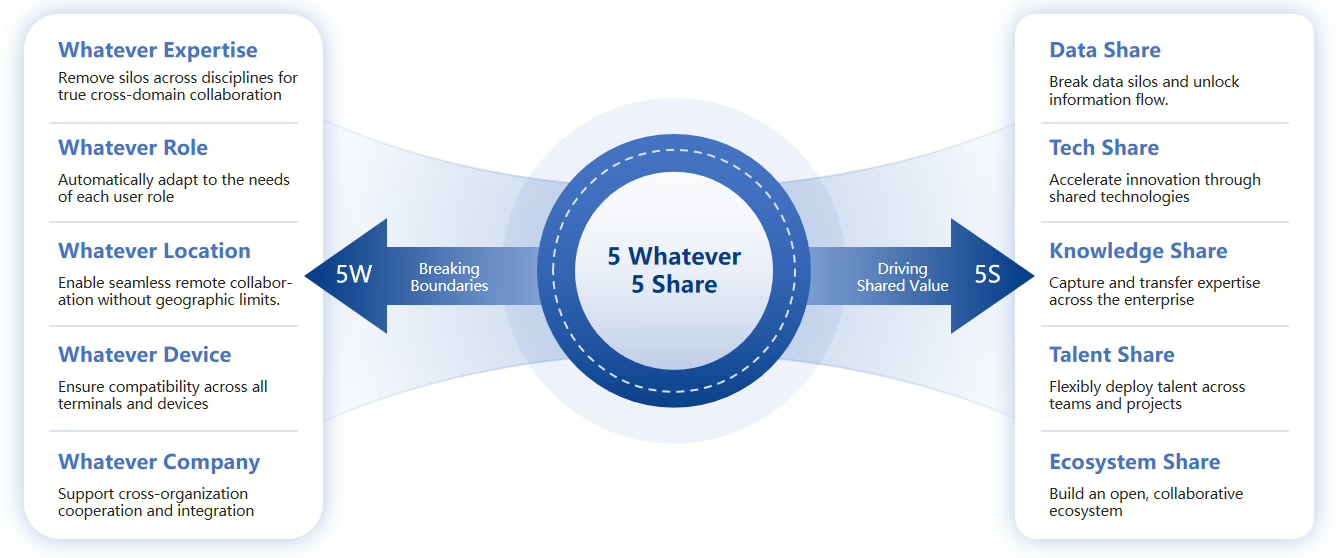
OiO’s integrated intelligent platform is founded on the “5 Whatever + 5 Share” principle, which systematically dismantles conventional physical and organizational barriers within the oil and gas sector.
By facilitating the seamless sharing of knowledge, talent, technology, ecosystems, and data throughout the value chain, the platform enhances cross-disciplinary collaboration, supports remote operations, promotes organizational interoperability, and ensures deep data integration. This approach establishes a new paradigm for open, intelligent, and highly efficient collaboration across the industry as a whole.
Jurassic Software is the only OSDU® Forum member in China. OSDU provides an open data foundation for the oil and gas industry, addressing core capabilities such as data standards, schemas, APIs, access mechanisms, and domain data services.
Building on this foundation, OiO further integrates business semantics, resource binding, rule orchestration, and intelligent execution capabilities, extending intelligence from data resources to business workflows and from intelligent analysis to closed-loop execution. Rather than replacing one another, OSDU and OiO form a layered and complementary architecture for intelligent oil and gas applications.
Unified data models and industry standards
Data storage, search, file management and dataset services
Access control, compliance and data lifecycle management
Standard APIs and interoperability foundation for seamless integration
Mapping standardized data resources to business semantics and context
Link data resources to business entities and context
Transform data into business views
Align data with business semantics and workflows
Five-dimensional business ontology modeling, defining the smallest business units (MBU)
Link business questions with tasks, orchestrate workflows and drive execution
Orchestrate intelligent agents to utilize models, tools and knowledge
Evidence chain, knowledge graph and feedback loop for continuous optimization
Standardized · Open · Trusted
Data can be accessed and shared
Semantic Understanding · Resource Connection
Business becomes visible and manageable
Intelligent Execution · Continuous Feedback
Closed-loop execution and continuous optimization
Sudden water cut increase in a well from 55% to 78%, causing a drop in oil production. On-site team required response recommendations within 2 hours.
Reservoir engineers, production engineers, and surface process engineers collaborated on a unified platform for the well. They analyzed a comprehensive evidence chain, which included liquid production and water cut curves, the response to water injection, comparisons with offset wells, operational history, and surface pressure differentials and conditions.
Field operators: Viewed exception alerts + handling steps + safety tips.
Engineers: Accessed root cause reasoning chain + comparative analysis + recommended actions.
Management: Monitored production impact/risk level/progress.
Real-time collaboration was established between overseas field teams and domestic research institutes, employing synchronized screens to replace the traditional use of email threads and alignment meetings.
Field personnel employed explosion-proof phones and tablets to access information regarding well exceptions and conditions, while engineers conducted thorough analyses on computers.
Project companies, research institutes, and service providers shared data and conclusions based on permissions, with all recommendations being traceable to their source.
JuraSearch integrated time-series, operational, injection, offset well, and surface process data with one click, auto-generating an evidence package.
The same diagnostic components/chart templates/report formats were reused across all wells, eliminating the need to rebuild charts and tables for each case.
The logic for determining the cause of the “sudden water cut increase” and the response pathway were documented as a case card + rule, enabling automatic recall for similar future issues.
A small number of domestic experts provided remote support for multiple wells, while on-site trainees could follow systematic steps to complete diagnostics and handling.
Recommendations were instantly converted into work orders and pushed to EAM/CMMS (or operational systems), enabling closed-loop tracking and review.
Reduced from half a day or a full day to 30 to 60 minutes.
From time-consuming manual data search and repeated coordination efforts toward automated data linking, supported by a single, integrated collaboration interface.
From reliance on isolated human knowledge to the codification and standardization of expertise, establishing a library of enterprise-wide, replicable rules, cases, and templates.
Quick Links
About Us