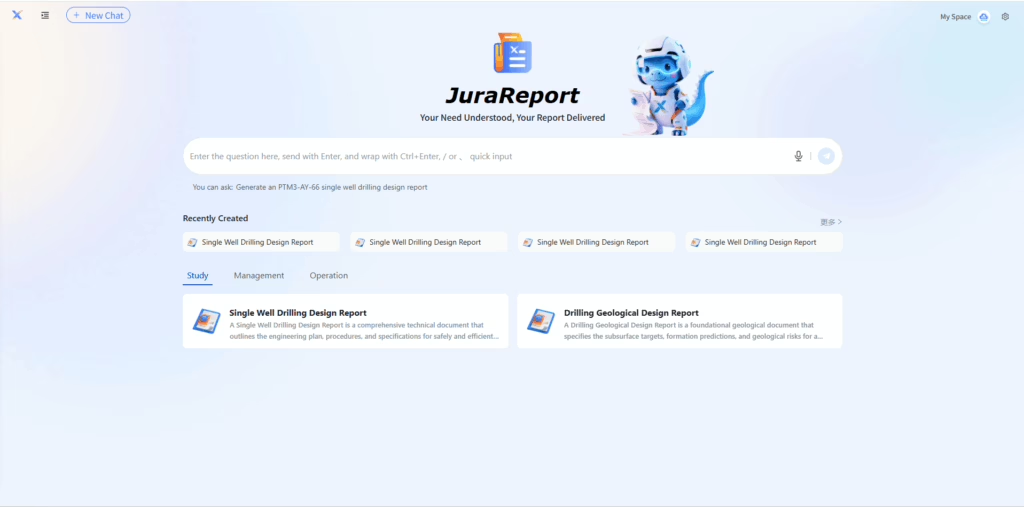
Empower users to transform natural language descriptions into highly structured, data-centric, and industry-compliant reports with one click.
Intelligent Report Generation Platform
Empower users to transform natural language descriptions into highly structured, data-centric, and industry-compliant reports with one click.
JuraReport is an intelligent research report generation platform designed for research and analysis scenarios in the oil and gas industry. The platform consolidates industry experts’ research workflows, analytical methods, tool capabilities, and deliverable standards into repeatable and executable research workflows.
After a user selects a specific research scenario, the platform follows a predefined process to progressively complete data acquisition, analytical processing, parameter calculation, map and chart generation, result summarization, and interim deliverable output. It then automatically organizes the outputs from each research node into a complete research report.
Traditional reporting requires cross-team collaboration and exhaustive revisions, often spanning several days.
Professionals spend excessive time on data extraction, visualization, and formatting, detracting from high-value core analysis.
Multi-author workflows frequently lead to fragmented structures and inconsistent linguistic styles or formatting across long-form documents.
Manual integration of disparate real-time data sources is slow and highly susceptible to human error.
Automatically parse the structure, chapters, and styles of existing DOCX reports, converting established reporting standards into reusable templates.
Integrate data from business systems, repositories, and user files, with automated parsing, cleansing, unit conversion, and format standardization.
Generate professional report drafts from templates, structured data, and contextual information while retaining expert review and approval.
Map template placeholders to structured parameters for accurate data insertion, then generate standardized and reviewable conclusions based on predefined rules.
Insert professional charts, diagrams, and tables into predefined report sections while automatically maintaining captions, numbering, and cross-references.
Combine text, data, tables, graphics, and variables into complete editable DOCX reports with consistent structure, formatting, and references.
Instantly interpret natural language queries to identify report types and apply the optimal professional template.
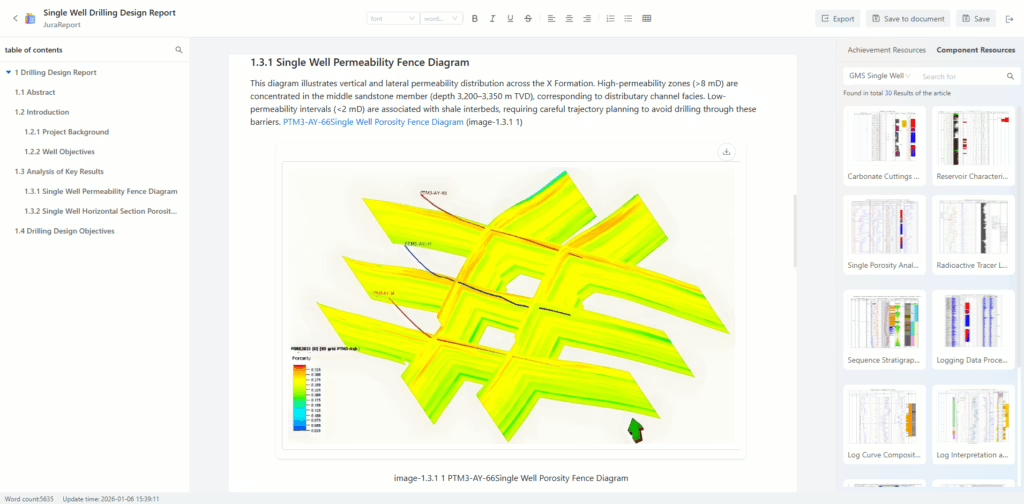
Connect to real-time sources to autonomously extract datasets, perform analysis, and populate precise charts, tables, and graphics.
Feature automated linguistic refining, structural consistency checks, and clarity enhancement, enabling one-click rewriting for tone and flow.
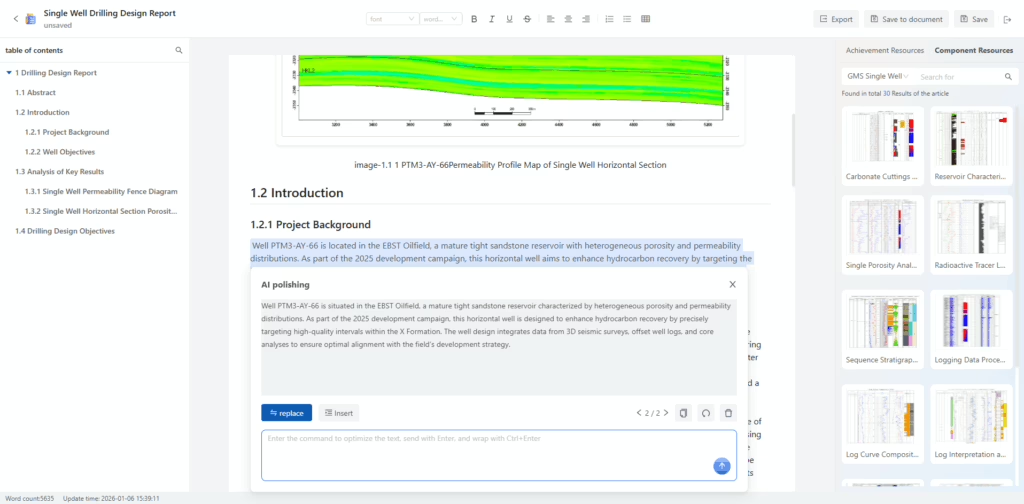
Guarantee rigorous logical structuring and unified formatting, delivering a seamless, AI-driven transition from initial draft to final publication.
Designed for the annual reserve evaluation of oilfield enterprises, this scenario addresses the challenges of periodic, standardized, and highly collaborative research work, including scattered data sources, complex data consistency checks, repetitive research tasks, and unstable deliverable quality. The platform leverages standardized research templates, unified data organization, automated data extraction and validation, chart and content generation, collaborative management, and version tracking to systematize stable, rule-based, and recurring research nodes in reserve evaluation. It helps researchers shorten data preparation time, reduce repetitive work, improve collaboration efficiency, and ensure the consistency, standardization, and traceability of evaluation results.
Multi-source data requires extensive manual organization, checking, and validation before research begins.
Researchers must repeat data extraction, table creation, chart generation, and similar analysis every year.
Multiple chapters, blocks, and contributors make updates and coordination difficult when data or analysis changes.
Differences in analysis methods, wording, and formats increase the workload for final review and standardization.
Define fixed chapters, workflows, data relationships, chart positions, and analysis logic in advance.
Automatically extract, align, validate, and organize multi-source reserve evaluation data.
Generate tables, charts, and standard analysis content based on templates and data logic.
Assign tasks, consolidate outputs, and retain records for tracking, review, and reuse.
Reduce the time spent on searching, organizing, and verifying multi-source data, enabling research work to move faster into the analysis stage.
Automatically generate fixed workflows, commonly used charts, and standardized content to reduce repetitive work in annual evaluations.
Enable project leaders to clearly track progress, responsibilities, and revision status across chapters, blocks, and research nodes.
Unify data sources, research templates, and report formats to improve the consistency, standardization, and traceability of reserve evaluation results.
Designed for monthly production performance analysis in oilfield enterprises, this scenario automates data retrieval, chart generation, analysis drafting, and report output. It helps technical staff reduce repetitive reporting work and focus more on anomaly identification, measure evaluation, and production decision support.
Monthly production analysis is dominated by manual data exporting, cleaning, and charting, consuming excessive technical resources.
Disparate systems for production, injection, and pressure data require manual alignment and validation, leading to errors and delays.
Output quality heavily relies on individual expertise, resulting in unstable reporting standards and analytical depth.
BI tools lack narrative capabilities, while Excel lacks automation. Manual splicing of data, visuals, and text remains a bottleneck.
Auto-retrieve production, injection, and pressure data; perform auto-validation and calibration alignment.
Auto-generate trend charts and injection-production curves based on preset templates to ensure style consistency.
Auto-generate analysis drafts covering trends, anomalies, and stimulation effects to diagnose changes and guide next steps.
Seamlessly compile data, charts, and text into a single deliverable for final review and distribution.
Compress multi-day manual tasks into a shorter timeframe, drastically reducing the time spent on data wrangling and drafting.
Offload repetitive data processing to the system, freeing up technical staff to focus on anomaly diagnosis, measure evaluation, and optimization strategies.
Unify analytical structures and visual standards across all assets. Automated drafting minimizes human variability, ensuring stable and comparable deliverables.
Institutionalize data logic, templates, and frameworks into reusable assets, supporting continuous iteration and enterprise-wide scalability.
JuraReport tackles slow reporting and limited AI utility in oilfield operations by converting natural language into structured insights. It automates template matching and real-data integration, eliminating complex setup. By upgrading research from “following procedures” to “stating needs,” JuraReport offers a flexible, intelligent gateway for every business role.
General AI assistants can answer isolated queries but fail to synthesize data, visualizations, and logic into a structured research deliverable.
Generic AI writing tools lack access to real operational data (reserves, production, KPIs), resulting in content that lacks factual grounding and is unsuitable for formal business use.
Complex configuration involving templates, data mapping, and workflows creates a steep learning curve, hindering adoption by management and cross-functional teams.
Traditional processes cannot support high-urgency scenarios (e.g., pre-meeting briefings, spot analyses) with the speed required to generate actionable materials.
Users initiate reports via simple commands (e.g., "Generate block dynamics for May"), and the system intelligently matches the intent to the appropriate research template.
The system autonomously fetches corresponding operational data (reserves, production, etc.), ensuring outputs are grounded in verified enterprise data, not generic AI guesses.
Leveraging professional templates and analytical logic, the system auto-generates structured deliverables, including data narratives, trend analysis, anomaly detection, and recommendations.
Users iterate via chat (e.g., "Expand on trend analysis"), allowing the system to dynamically adjust content and enhance output accuracy and usability.
Users no longer need expertise in template configuration or data mapping; simply describing requirements in natural language triggers the automated research workflow.
For standardized structures with robust data, draft reports are generated rapidly to support meetings, analysis, and decision-making.
Evolving from "Q&A" to "Deliverable Generation," AI now organizes analytical content based on business logic to produce actionable research materials.
Non-specialists such as managers and cross-functional teams can obtain analyses via conversation, increasing the platform's value across business roles.
Transitioning from document generation to full research automation.
Built around industry-specific workflows and professional methodologies.
Unifying processes, metrics, formats, and quality control.
Reducing repetitive tasks to focus on critical analysis.
Quick Links
About Us