
Data Governance Solutions for
the Oil & Gas Industry

We do not just govern data,we govern the core of your business. By building an integrated, business-oriented data management platform, we empower you to convert data into precise decision-making capabilities and driving force for business innovation. This enhances efficiency across the entire value chain and truly unlocks the deep-seated value of your data.

Are You Facing These Data-Related Challenges?

Large volumes of archived scanned documents, in multiple languages and inconsistent formats, remain unused as sleeping data.

Engineers spend up to 70% of their time searching across multiple systems, extracting data, and aligning inconsistent datasets.

In mature oilfields, identifying the root cause of anomalies relies heavily on experience, while traditional AI models lack interpretability.

Annual dynamic analysis reports and well location justification reports are highly labor-intensive, with slow charting and narrative writing processes.

Why Choose Jurassic Software’s Data Governance Solution?

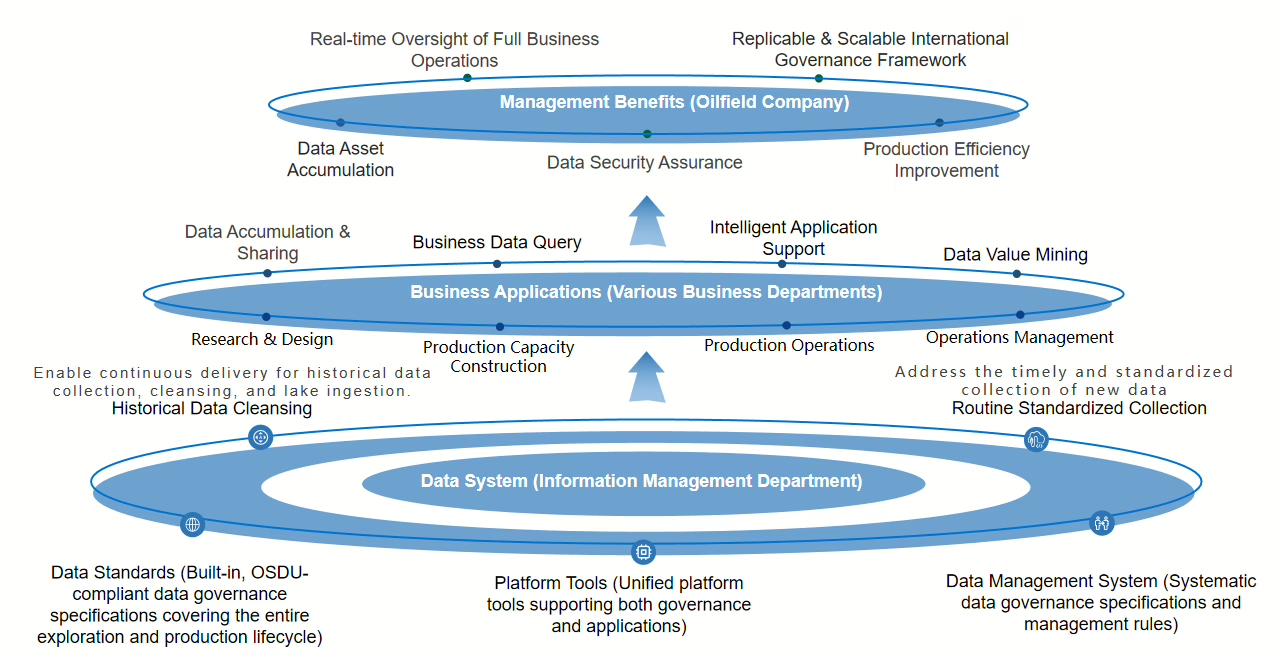
Jurassic Software’s Data Governance Solution is built on a deep understanding of oil and gas business operations, supported by industry-standard frameworks and platform-based tools. It helps enterprises achieve standardized data governance, continuous data control, service-oriented data application, and intelligent enablement.


From historical data governance to standardized management of newly generated data, and from business data services to large language model and AI application support, Jurassic Software builds data governance and intelligent service capabilities tailored to the oil and gas industry, enabling data assets to be truly transformed into business value.

Core Advantages

Core Business Scenarios

Standardized Source Data Collection

Inconsistent Data Collection Standards: Different departments, roles, or project stages use varied templates, resulting in inconsistent field names, entry rules, and units.
 
Poor Process Control:​ Heavy reliance on Excel spreadsheets, paper forms, and manual data entry leads to frequent omissions, errors, delays, and duplicate records.
 
Weak Source Data Quality:​ The absence of automated validation means data issues are often discovered only during aggregation or analysis.
 
New Data Retention Failure:​ Daily operational data is not integrated into unified governance, causing historical efforts to be repeatedly undermined.
Standardized Collection Framework: Define key attributes—including naming conventions, definitions, units, and validation rules—to establish uniform data collection templates.
 
Proactive Quality Assurance: Integrate validation logic (completeness, consistency, timeliness) directly into the intake process to ensure data accuracy upon creation.
 
Multi-Modal Data Ingestion: Support diverse input methods such as manual entry, batch import, mobile capture, system APIs, IoT feeds, and document parsing.
 
Closed-Loop Governance Workflow: Implement a “Collect–Validate–Review–Approve” lifecycle with clear role-based accountability for all stakeholders.
Sustained Standardization of Incremental Data: ​Ensure all new data follows unified standards upon entry, preventing fragmented and inconsistent reporting.
 
Lower Governance Costs: ​Detect and correct data issues at source to reduce downstream cleansing, reconciliation, and rework.
 
Clear Accountability Mechanism: ​Apply consistent standards, rules, workflows, and reviews to strengthen control and ownership.
 
Support Business and Intelligence Needs: ​Deliver reliable data for operations, project management, analytics, intelligent query, and AI applications.

Multi-Source Heterogeneity Leading to Incomprehension and Incomplete Retrieval: Data formats vary widely, and the lack of a unified parsing mechanism leads to data scattered across multiple isolated systems, creating a high “data wall.”


Unreliable Quality Leading to Reluctance to Use: Common issues include inconsistent historical data entry standards, missing key metadata, unit conflicts, and chaotic coordinate systems.


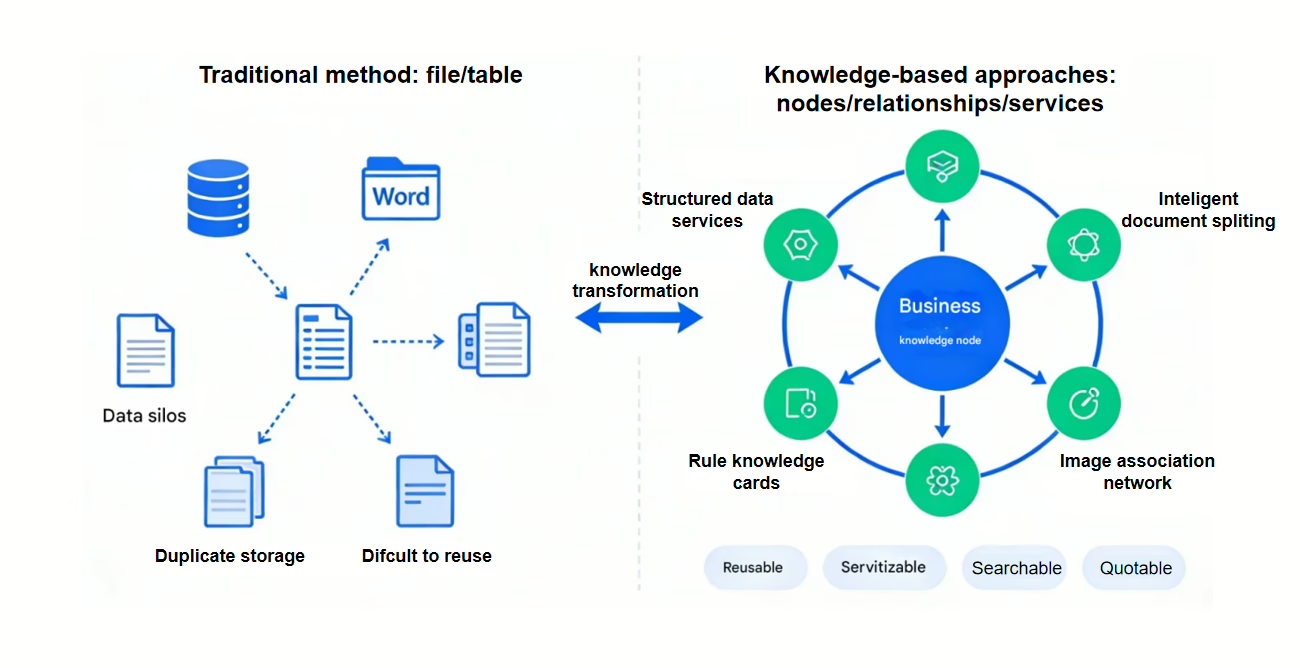
Tacit Knowledge Leading to Inability to Transfer: The most valuable understanding of oilfield mechanisms and development experience is submerged in tens of thousands of reports and expert minds. This implicit knowledge cannot be retrieved or passed down through digital systems.

Data Aggregation: Break down barriers between structured data, unstructured data, and specialized software, enabling one-stop integration of industry-wide data.


Structured Data: Slice and extract tags based on business nodes, allowing tables/fields to align with the business semantic framework.


Unstructured Documents: Split documents by chapters or topics, forming searchable and traceable knowledge fragments.


Quality Inspection Rule Management: Embed business rules into the platform, enabling quality issues to be pinpointed to specific business nodes and their impact scope. Data cleansing is performed based on problem classification.


Asset Management + Quality Inspection Operations Management: Establish a data asset system that is manageable, traceable, and closed-loop.

Unified Management: From Data Fragments to Digital Assets: Transform decades of scattered, multi-source materials into unified, standardized, and accessible business assets. Data retrieval time is reduced from days to seconds.


Trustworthy and Traceable Decision Evidence Chain: Every piece of historical data after governance is complete, reliable, and traceable, enhancing the scientific rigor and trust in decision-making.


Digitization and Inheritance of Expert Knowledge: Through knowledge-driven governance of historical data, dispersed expert experience is transformed into enterprise-level knowledge assets.

Historical Data Governance

Data Quality Improvement

Insufficient Data Completeness: Missing fields, records, attachments, and core attributes disrupt downstream analytics and application.
 
Inadequate Data Accuracy: Entry errors, unit mismatches, linkage failures, and outliers degrade decision-making credibility.
 
Cross-System Inconsistency: Entity discrepancies across systems and versions cause conflicting metrics and misaligned business definitions.
 
Ineffective Issue Remediation: Unclear ownership, poor tracking, and weak review processes lead to recurring quality failures.
Establish Quality Rule System​: Define rules for completeness, accuracy, standardization, consistency, uniqueness, and timeliness aligned with oil & gas business needs.
 
Conduct Multi-Dimensional Quality Checks​: Perform batch reviews of historical data, validate new data at source, and monitor critical datasets periodically.
 
Build Closed-Loop Remediation:​Implement “Check → Identify → Assign → Rectify → Verify” workflow with clear ownership, timelines, and acceptance standards.
 
Develop Quality Metrics:​ Track compliance, resolution, recurrence, and quality trends to support continuous improvement and accountability.
Systematic Issue Detection​: Automatically identify and categorize gaps, errors, duplicates, and inconsistencies to boost efficiency.
 
Accountability & Traceability:​ Trace issues to specific objects, sources, and owners to ensure trackable and manageable remediation.
 
Improved Data Reliability:​ Enhance the quality and stability of core data through continuous checks and closed-loop fixes, building user trust.
 
Intelligence Enablement: Reduce manual effort and increase confidence in reporting, analytics, conversational BI, and AI outputs.

Translation Barrier Between Business and IT​: Traditional data services are based on database tables and fields. Business personnel struggle to understand table structures, while IT developers often lack a grasp of business logic, leading to high communication costs in data retrieval and usage.


Developers’ Logic Trap​: When calling data, developers often need to write complex join queries and calculation logic. Any change in business rules can cause all downstream applications to fail.


Service Granularity: Too Coarse or Too Fine​. Traditional APIs either expose entire tables directly or are rigid, page-specific interfaces that cannot be flexibly reused.

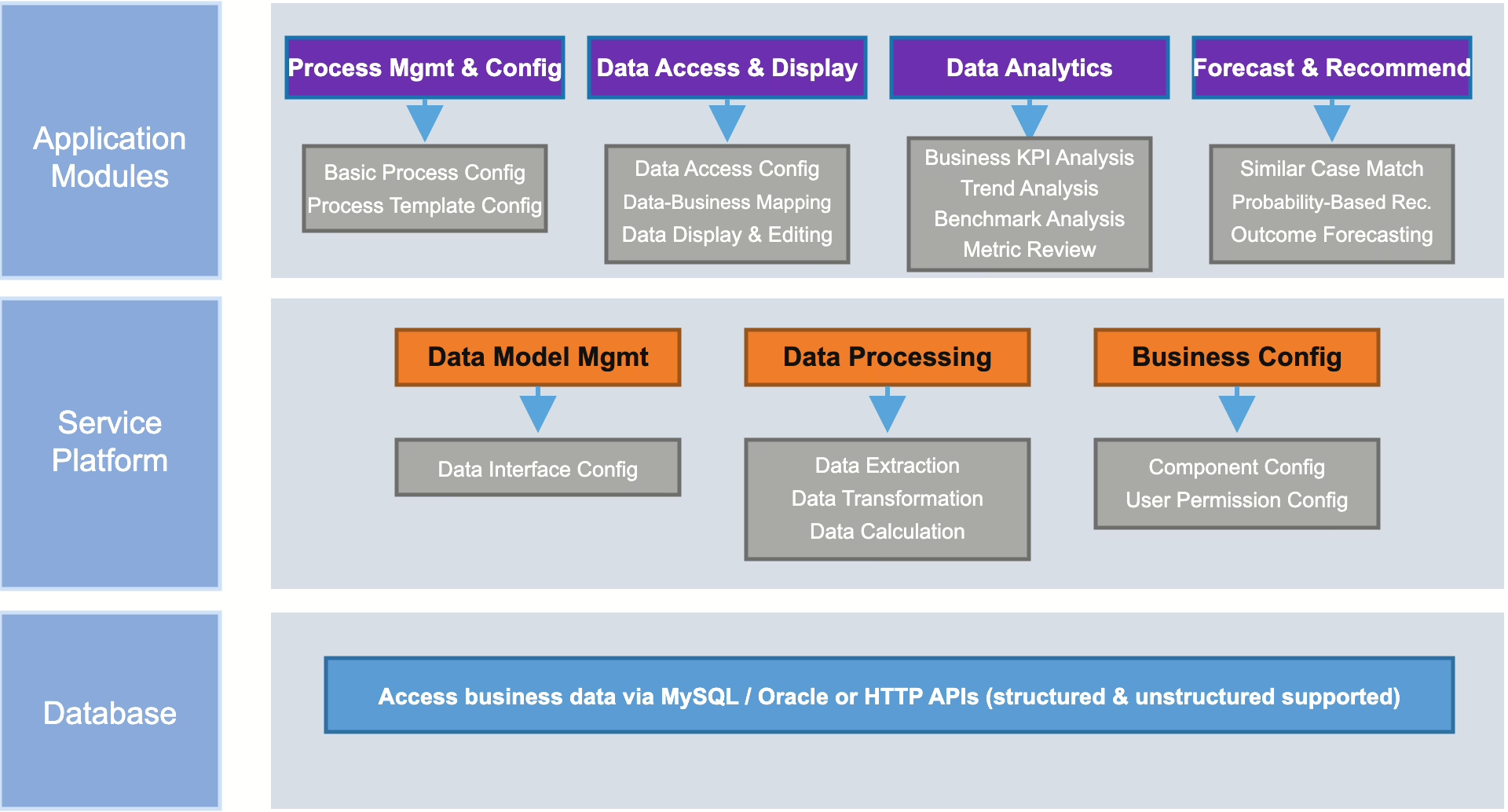
Business Query: Business query / catalog query / object query / knowledge encyclopedia, with retrieval entry points organized around business nodes.
 
Data Service: Business node-based data services + API services, enabling rapid data reuse for business systems.
 
Intelligent Services:​ Intelligent Q&A / intelligent BI / intelligent data query / intelligent analysis, establishing a unified entry point from data → analysis → decision.

Transformative Improvement in Research and Efficiency: Business experts achieve self-service data access. Data acquisition time is reduced from weeks or days to seconds, allowing engineers to focus on research rather than data preparation.


Application Development Cycle Shortened by Over 60%: With standardized business data services, building new applications becomes as simple as assembling building blocks. Applications gain exceptional agility during rapid iterations.


Trustworthy Industry Intelligent Services: Address the issue of AI making authoritative but incorrect statements in specialized fields. Through business node services, AI outputs are highly interpretable and backed by complete evidence.

Providing Unified Data Services

Case Study

XX Group is a large energy enterprise undergoing digital transformation and implementing its Smart Oilfield strategic plan. Its operations involve complex development and production processes, supported by massive data assets.

Business Challenges

Data Volume & Fragmentation: 58 development and production systems, 10 core databases, ~5,600 datasets, and ~1.8 billion data records


Application Proliferation: 58 independently or centrally built systems with 3,145 business functions


Broad User Base: Multi-level users from headquarters to field operations, including leadership, managers, engineers, and platform operators


Governance Urgency: Pressing need to unify data standards, integrate siloed systems, and improve data integration under the Smart Oilfield initiative

Solution & Implementation​

XX Group establishes a unified development and production data management system through a five-pillar approach:

Standardization​
Revised and unified data standards covering 2,541 core business datasets and 35,836 data items
  1. Established collection standards and detailed guidelines across 475 collection roles and 71 departments
  2. Implemented 14,085 data validation rules
Enabled semi-automated, standardized data collection through unified collection services
  1. Built a unified data platform for historical data aggregation and governance
  2. Cleaned 600 million core database records to 512 million high-quality records
  3. Provided unified data services
  1. Consolidated 3,145 application functions into 1,905 optimized functions within a unified framework
  2. Added 504 new application functions

Business Value

Data Standard

Disparate & Heterogeneous → Unified Standard

Data Assets​

Isolated Silos → A Unified Data Lake

Data Collection

Untimely & Incomplete → Comprehensive Collection

Data Development

Diverse Interpretations → Unified Caliber

Data Application

58 Sets → One Platform / Unified Entry

Turn Your Data into Your Most Strategic Asset

Discover how Jurassic Software's data governance solution can unlock your data's full potential, drive intelligent decisions across your value chain, and build your AI-ready future.